Whiskey Sour
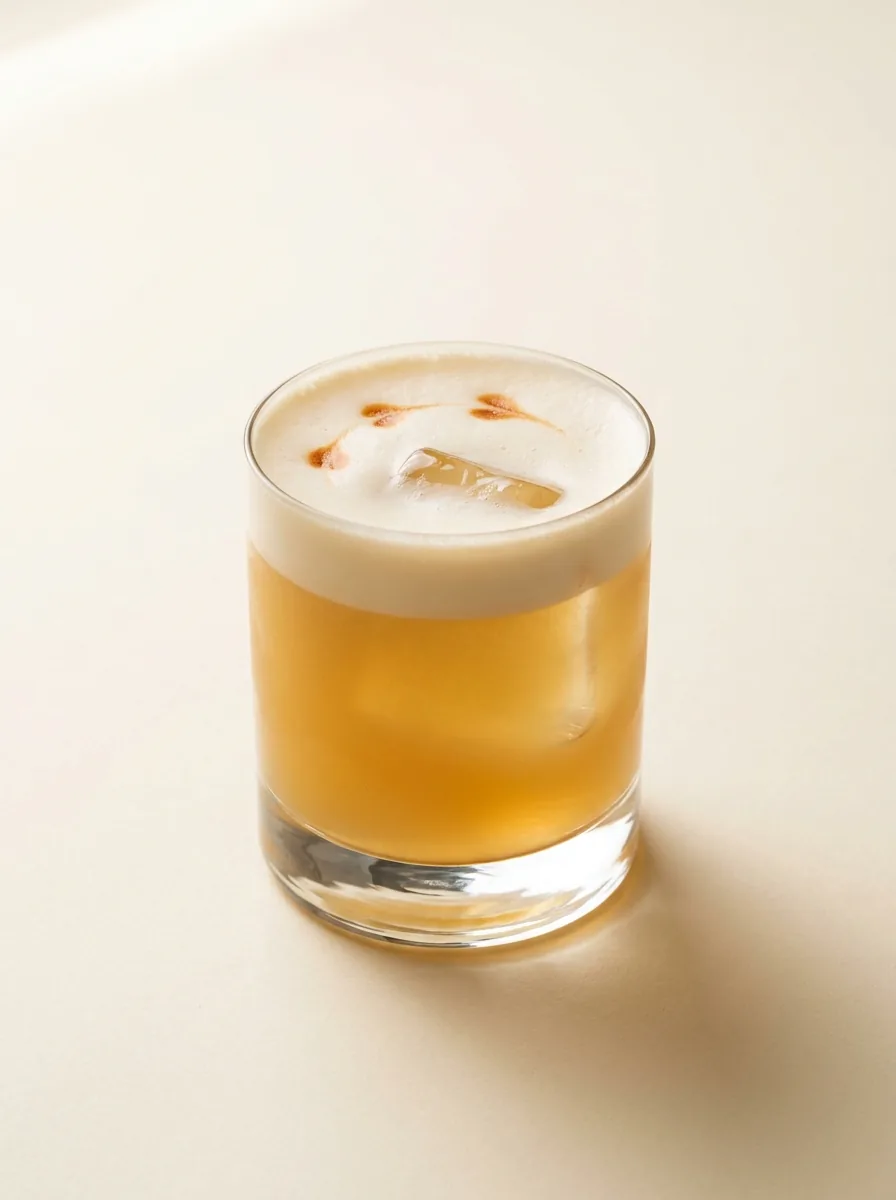
The Whiskey Sour is one of the enduring templates of classic cocktail making — a study in the balance between spirit, citrus and sugar, lifted by a dense, silken foam. Its structure has changed little in more than a century, which is precisely why it remains one of the truest measures of a bartender's judgement.
- Glass
- Rocks Glass (Old Fashioned)
- Ice
- Large fresh ice cubes
- Difficulty
- Easy
- Technique
- Single shake · Standard strain
Ingredients
- 50 mlBourbon
- 25 mlFresh Lemon Juice
- 20 mlSimple Syrup — 1:1
- 20 mlFOAMY WHITES
- 2 dashesAngostura Bitters
Method
- 01Fill a shaker with large ice cubes.
- 02Add bourbon, lemon juice, simple syrup and FOAMY WHITES.
- 03Shake hard for approximately 10–12 seconds.
- 04Strain into a rocks glass over fresh large ice cubes.
- 05Finish with Angostura bitters on the foam and serve immediately.
Build
- Glassware
- Rocks Glass (Old Fashioned)
- Ice
- Large fresh ice cubes
- Garnish
- 2 dashes Angostura bitters on the foam · optional orange peel
- Technique
- Single shake · Standard strain
Tasting notes
- Balanced Structure
- Fresh Citrus
- Silky Texture
- Rich Bourbon Finish
- Family
- Sour
Origin
- Era
- Mid-19th century
- Place
- United States
The Whiskey Sour belongs to the sour family, one of the oldest documented cocktail categories. Its earliest printed recipe appears in Jerry Thomas' 1862 Bar-Tender's Guide, though drinks built on spirit, citrus and sugar were already common in American bars. The addition of egg white — the version most bartenders now consider canonical — became widespread in the late 19th century. No single inventor is credited, and the precise origin remains uncertain. What is beyond dispute is its endurance: the Whiskey Sour has stayed on drinks lists continuously for more than 160 years.
Bartender notes
- Lemon juice loses its brightest aromatics within a few hours of pressing. Juice squeezed to order gives cleaner acidity and a foam that reads as fresh rather than flat.
- Choose a bourbon of at least 43% ABV. Lower-proof whiskeys are washed out by the citrus and syrup, while higher proof carries structure through dilution and finishes with weight rather than sweetness.
- Shake with large, dense cubes. They chill the drink quickly without over-diluting, so the bourbon retains body and the acidity stays defined once the cocktail is poured over fresh ice.
- A single hard shake of 10–12 seconds is enough. A dry shake with FOAMY WHITES adds no texture and only warms the ingredients before the ice can do its work.
- Standard strain, never fine strain. A mesh breaks the emulsion and thins the foam; the small ice fragments a Hawthorne lets through melt harmlessly on the fresh ice in the glass.
- The bitters on the foam are not decoration. Their spice cuts across the sweetness and lifts the aroma on every sip — omit them and the drink reads noticeably flatter.
FOAMY WHITES Note
FOAMY WHITES replaces fresh egg white without changing the shaking process. A single wet shake produces the dense, stable foam a dry shake would build with egg, which means less handling, more consistent texture across a service, and no risk of protein binding with the bourbon.