Principle
Why cocktail foam collapses
A good foam is temporary by nature. The useful question isn't whether it will collapse, but why — and whether it does so before the drink has had its moment.
The question
Why does the foam on a Sour change, and eventually disappear?
Revised 2026-08-17
Make two identical Sours
Make two identical Sours. Serve one. Leave the other on the bar.
At first, not much seems to happen.
Then look closely.
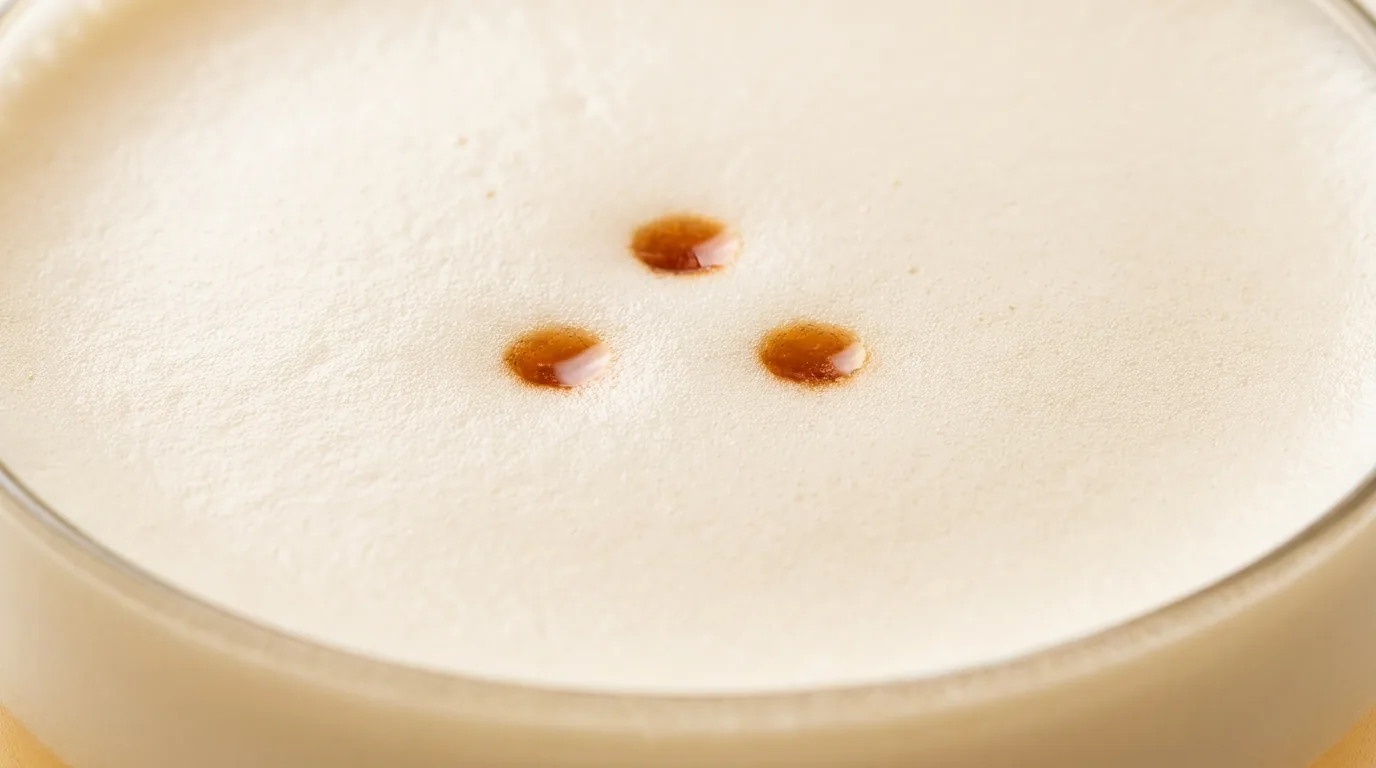
The foam begins to change. Liquid moves down through it. The surface becomes a little less uniform. Some bubbles disappear; others become larger. What began as a dense, almost matte cap gradually becomes wetter, coarser and thinner.
Behind the bar, we tend to give all of this one name: the foam collapsed.
But that's slightly misleading.
Foam doesn't have one single collapse mechanism. What we see in the glass is the result of several physical processes happening together — particularly drainage, coalescence and disproportionation. Protein-stabilised food foams resist those processes, but they don't stop them forever. [1]
And once you understand those processes, watching a Sour age becomes much more interesting.
First: what are we actually looking at?
Before we can understand why foam disappears, we need to understand what foam is.
It isn't really a white substance sitting on top of the cocktail.
It's a structure.
A liquid foam is gas dispersed through liquid: thousands of bubbles separated by thin liquid films. In protein-stabilised foams, proteins adsorb at the air–water interface and help create stabilising interfacial layers. Protein conformation, flexibility and interactions at that interface contribute to foam stability. [1]
So when you shake a Sour with egg white, you're not simply mixing egg white into the drink.
You're creating thousands of tiny air–liquid interfaces and asking proteins to help keep them apart.
That's rather beautiful when you think about it.
1. The liquid drains
Gravity gets to work almost immediately.
Between the bubbles is liquid. Over time, some of that liquid drains downward through the foam.
As drainage progresses, the liquid distribution and the thin regions separating bubbles change, leaving the structure increasingly vulnerable to destabilisation. Drainage is one of the fundamental processes involved in the ageing and eventual failure of liquid foams. [1]
And here's the interesting bit behind the bar.
A foam can still look tall while already getting worse.
The height may remain impressive, but the texture can be changing underneath.
That makes foam height a surprisingly crude measure of quality.
A huge white head isn't necessarily a good one.
We care about bubble size, texture, drainage, stability and — ultimately — how it feels when the guest drinks it.
2. Bubbles merge
Now imagine two neighbouring bubbles.
Between them is a thin liquid film.
If that separating film fails, neighbouring bubbles can merge into a larger bubble.
That's coalescence.
Repeated across a foam, coalescence contributes to a coarser bubble structure and eventually to visible foam deterioration. It is one of the recognised mechanisms of liquid-foam destabilisation. [1]
This gives us another useful distinction: foam can deteriorate before it disappears.
If your Sour still has a centimetre of foam but the surface has gone from tight and satin-like to large and soapy-looking, the foam hasn't remained unchanged just because it's still there.
Which is why we're interested in more than the glamour shot immediately after the pour.
Give it a few minutes.
That's where foam starts telling you what it really is.
3. Small bubbles can disappear while larger ones grow
This one is less intuitive.
Two bubbles don't necessarily need to physically merge for the foam to become coarser.
Gas can redistribute between bubbles, with smaller bubbles shrinking while larger ones grow. This process is generally described as disproportionation in foam science and contributes to changes in bubble-size distribution as a foam ages. [1]
So when an ageing Sour develops larger bubbles, we shouldn't automatically imagine lots of bubbles physically smashing into one another.
Different destabilisation mechanisms can contribute to what we're seeing.
You don't need to diagnose which process is dominating while you're six tickets deep.
But knowing that more than one exists changes the way you look at the surface.
And it reinforces something we're going to return to throughout this Handbook: bubble size matters.
So why does one Sour survive beautifully while another falls apart?
Now it gets complicated.
Because a cocktail isn't egg white whipped in water.
It's a multicomponent system.
There may be protein, water, ethanol, acid, sugar, flavour compounds, oils and whatever water we introduce through dilution.
Every one of those exists in the same liquid environment in which our foam has to form and survive.
That means seemingly small changes to a spec may affect more than flavour.
But this is also where we need to be disciplined.
Most controlled foam research isn't conducted in Whisky Sours.
A result measured in a model egg-white or protein solution can teach us about an underlying mechanism.
It does not automatically tell us exactly what will happen in your cocktail.
That's where published science should stop pretending to be bartender advice — and where controlled testing becomes interesting.
Sugar: more foam and more stable foam aren't the same thing
Sugar gives us a lovely example.
In controlled egg-white protein systems, increasing sucrose increased solution viscosity and decreased foam overrun. At the same time, sucrose could improve wet-foam stability by affecting the continuous phase and interfacial properties. [3]
That's a useful little paradox: a system can make less foam and still make more stable foam.
More isn't automatically better.
And stable isn't automatically beautiful.
A bartender cares about the combination: volume, texture, bubble size, mouthfeel and how the foam develops while the drink is being consumed.
Acidity: important, but not a one-line rule
Proteins respond to pH because their charge, interactions and behaviour depend partly on their surrounding chemical environment.
Controlled work involving egg-white proteins has shown that pH can materially alter foamability and other foam properties. [4]
But we're going to resist turning that into: more acid = better foam.
The cited work is not a controlled Sour experiment. It examined protein systems under defined pH conditions.
A cocktail contains multiple components, and changing citrus changes far more than pH alone.
So the useful conclusion is: acidity is a real variable in protein foaming, but the effect of changing acidity in a finished cocktail should be demonstrated rather than assumed from a simplified laboratory system.
That's a perfect Handbook experiment.
Same Sour. Same everything we can control. Change the acid systematically.
Then watch what happens.
Fat: this one deserves our suspicion
Anyone who has made meringue has probably heard that even a little yolk can cause trouble.
There is good evidence behind that observation.
In a controlled 2009 study of liquid egg white, yolk contamination at just 0.022% by weight on an as-is basis caused significant reductions in foaming capacity and foaming speed. The neutral-lipid fraction of the yolk caused the major detrimental effect observed in that experiment. [5]
That's a remarkable number.
But don't turn it into another bad rule.
It does not establish that every cocktail ingredient containing fat at some particular concentration will destroy your foam.
Yolk is a specific material and cocktails are much more complicated systems.
What it tells us is that lipid contamination can strongly interfere with the foaming performance of liquid egg white under controlled conditions.
If one spec foams beautifully and another doesn't — and the second introduces a lipid-rich ingredient — that's worth investigating.
And then there's dilution
This deserves a small detour because bartenders use the word constantly.
In cocktail practice, dilution usually means the water incorporated into the drink as ice melts during chilling and mixing.
During shaking we're simultaneously mixing, aerating, chilling and diluting.
And chilling and dilution are intimately connected.
Professional cocktail experiments by Dave Arnold and collaborators explored the relationship between shaking, ice, temperature and dilution and found that, under the conditions they tested, chilling and dilution tracked closely together. [6] [7]
So dilution isn't simply accidental damage inflicted on a cocktail while we're trying to make it cold.
It is part of the physical process of preparing the drink.
What about alcohol?
Ethanol clearly changes the physical and chemical environment of a cocktail.
But for this article, we're stopping there.
We do not currently have evidence strong and cocktail-specific enough in this source set to turn that general fact into a reliable bartender rule about how changing ABV affects an egg-white Sour's foam.
It would be easy to write: high alcohol destabilises foam.
It sounds plausible.
It may even match some practical observations.
But sounding plausible isn't our standard.
So for now: ABV is a variable we want to test, not a rule we're ready to teach.
What about the shake?
Here's another distinction worth keeping.
Food-foam research distinguishes between the ability of a system to create foam and the stability of the resulting foam. Changes in formulation can improve one while worsening the other — the sucrose study above is a particularly clear example. [3]
That's enormously useful behind a bar.
A technique can give you an impressive head immediately after pouring without necessarily giving you the texture or longevity you want.
So asking which shake makes the most foam isn't quite the right question.
We want to know: how much foam? What bubble size? What texture? How quickly does it drain? How does it feel against the lip? How does it look after two minutes? Five? And what did the extra technique cost us during service?
That's why dry shake, reverse dry shake and single shake deserve proper treatment rather than a winner-and-loser comparison.
One last curiosity: pasteurised egg white
There's an assumption worth challenging here too.
Pasteurised liquid egg white isn't necessarily one functionally identical material regardless of how it was processed.
Pasteurisation uses heat for microbiological control, and heat treatment can change egg-white protein structure and aggregation. A 2024 study found that the temperature–time pasteurisation treatments it tested substantially reduced foaming capacity while slightly increasing foam stability. The researchers associated the loss of foaming capacity particularly with heat-induced protein aggregation and structural changes. [8]
Earlier work by Wang and Wang also found that the effect of heat treatment on liquid egg-white foaming depended on temperature and holding time. In their experiments, some controlled industrial processing and pasteurisation conditions did not produce the same deterioration, illustrating why the word pasteurised alone is not enough to predict exact foaming behaviour. [5]
That's important.
It means “pasteurised” doesn't tell a bartender everything they need to know about foaming performance.
Processing matters.
The resulting protein system matters.
And ultimately, performance in the actual cocktail matters.
This is also why we shouldn't assume that every liquid egg-white product will behave identically behind the bar.
So why does cocktail foam collapse?
Because foam is fighting its natural tendency to become less foamy.
The moment we finish shaking, the structure starts evolving.
Liquid drains through it.
Films separating bubbles can fail and bubbles can coalesce.
Gas can redistribute through the foam and the bubble-size distribution can change.
Protein layers at the air–water interface help resist destabilisation, while the formulation and physical environment influence how the foam behaves. [1]
That's why the goal isn't: make foam that never collapses.
That foam doesn't exist.
The goal is to create the right foam for the drink — the volume, bubble size, texture, stability and mouthfeel we want — and have it remain beautiful for as long as that drink needs it.
And once you start looking at a Sour that way, something rather nice happens.
You stop seeing white stuff on top of a cocktail.
You start seeing a structure.
And then you start wondering what else you can change.
A useful way to look at a failing foam
When a Sour isn't behaving, resist the temptation to immediately shake harder. First look at how it is failing. These are starting points, not complete diagnoses.
- It barely foams at all
- That's primarily a foam-formation problem. Start by looking at the foaming ingredient, its amount and condition, potentially interfering ingredients and technique.
- It looks excellent when poured, then quickly becomes wet
- Drainage is likely part of what you're seeing. The foam was created; the liquid structure is changing as it ages (see The liquid drains, above).
- It begins fine and becomes visibly coarse
- Changes in bubble structure are occurring. Coalescence, disproportionation or both may contribute.
- The same spec behaves differently from bartender to bartender
- Now consistency becomes the question. Dose, ingredient condition, temperature, dilution, shaking procedure and execution are practical variables worth controlling before inventing a more exotic explanation.
What we do not know
Foam is a multivariable system. Most of the controlled evidence above comes from model protein systems rather than finished cocktails, so it explains mechanisms rather than predicting your spec. Pretending every bad Sour has one universal fix would make this Handbook much easier to write. It would also make it much less useful.
What we want to try next
- Dilution vs foam — hold the recipe constant and deliberately vary water content. Measure initial foam characteristics and track visible change over time. The experimental method must be defined before results are published.
- Acidity vs foam — change acidity systematically while holding the remaining controllable variables constant. Do not infer the result from model protein systems. Measure it.
- ABV vs foam — create controlled systems across an alcohol range while keeping the rest of the formulation as comparable as practical. We currently treat the effect as an open question.
- Foam over time — develop a repeatable photographic protocol and document the same drink at fixed intervals. Potential observations include foam height, visible drainage and bubble-structure change. No quantitative claims until the measurement protocol is defined.
- Shake technique — compare dry shake, reverse dry shake and single shake across more than initial foam volume: texture, bubble structure, decay, dilution, temperature and service practicality.
- These experiments belong in the future Foam Handbook Test Library. Until we've run them properly, we do not publish the answers as though we have.
Sources & further reading
- 1Narsimhan, G. and Xiang, N. (2018). Role of Proteins on Formation, Drainage, and Stability of Liquid Food Foams. Annual Review of Food Science and Technology. 9. 45–63. doi:10.1146/annurev-food-030216-030009Peer-reviewed review of how protein-stabilised food foams form, drain and destabilise.
- 2Razi, S. M. et al. (2023). An overview of the functional properties of egg white proteins and their application in the food industry. Food Hydrocolloids. 135, 108183. doi:10.1016/j.foodhyd.2022.108183Peer-reviewed overview of egg-white protein functionality, including foaming.
- 3Yang, X. and Foegeding, E. A. (2010). Effects of sucrose on egg white protein and whey protein isolate foams: Factors determining properties of wet and dry foams (cakes). Food Hydrocolloids. 24(2–3). 227–238. doi:10.1016/j.foodhyd.2009.09.011Controlled protein-system study of sucrose, viscosity, foam overrun and wet-foam stability. Not a cocktail experiment.
- 4Lechevalier et al. (2009). Impact of pH on the interactions between whey and egg white proteins as assessed by the foamability of their mixtures. Food Hydrocolloids. 23(8). 2174–2181. doi:10.1016/j.foodhyd.2009.05.001Defined protein systems at controlled pH. Shows pH matters to foamability; it does not establish an optimal cocktail pH.
- 5Wang, G. and Wang, T. (2009). Effects of Yolk Contamination, Shearing, and Heating on Foaming Properties of Fresh Egg White. Journal of Food Science. 74(2). C147–C156. doi:10.1111/j.1750-3841.2009.01054.xControlled experiment on yolk contamination, neutral lipids, and the effect of heating temperature and holding time on foaming.
- 6Arnold, D. (2009). Cocktails: The Science of Shaking. Cooking IssuesProfessional cocktail experimentation, not peer-reviewed research. Read as bar-side testing.
- 7Arnold, D. (2009). Tales of the Cocktail: Science of Shaking II. Cooking IssuesFollow-up professional cocktail experiments on ice size, temperature and dilution. Not peer-reviewed research.
- 8Fan, X. et al. (2024). Protein aggregation caused by pasteurization processing affects the foam performance of liquid egg white. Food Chemistry. 446, 138881. doi:10.1016/j.foodchem.2024.138881Peer-reviewed study of pasteurisation temperature–time treatments, protein aggregation, foaming capacity and foam stability.
If you want to go further
- Razi, S. M. et al. (2023). An overview of the functional properties of egg white proteins and their application in the food industry. Food Hydrocolloids. 135, 108183. doi:10.1016/j.foodhyd.2022.108183The broadest single starting point on what egg-white proteins do, and why processing changes it.
- Narsimhan, G. and Xiang, N. (2018). Role of Proteins on Formation, Drainage, and Stability of Liquid Food Foams. Annual Review of Food Science and Technology. 9. 45–63. doi:10.1146/annurev-food-030216-030009If you read only one paper on foam physics, read this one.
About this Handbook
The Foam Handbook is published by FOAMY WHITES, who make a pasteurised liquid egg white for bars. We write about foam the way we would explain it across the bar — including where our product is not the answer.